
Skin in the game, applied, as a rule, reduces the effects of the following divergences that grew with civilization: those between action and cheap talk, consequence and intention, practice and theory, honor and reputation, expertise and charlatanism, concrete and abstract, ethical and legal, genuine and cosmetic, merchant and bureaucrat, entrepreneur and chief executive, strength and display, love and gold-digging, Coventry and Brussels, Omaha and Washington, D.C., human beings and economists, authors and editors, scholarship and academia, democracy and governance, science and scientism, politics and politicians, love and money, the spirit and the letter, Cato the Elder and Barrack Obama, quality and advertising, commitment and signaling, and, centrally, collective and individual.
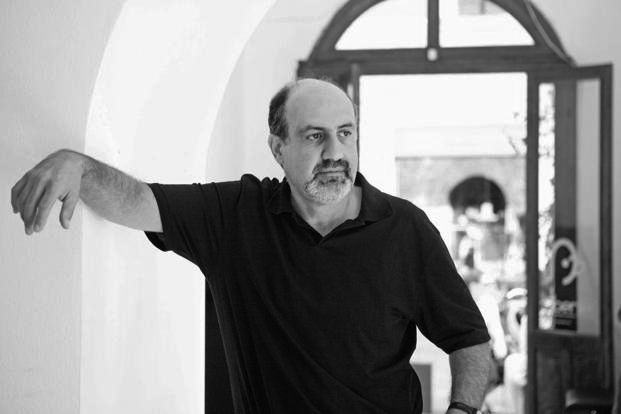
The maxim of: “Beware of the person who gives advice, telling you that a certain action on your part is ‘good for you’ while it is also good for him, while the harm to you doesn’t directly affect him.” Is crucially important to every one of us and it is the central and linchpin idea of Nassim Taleb’s moral philosophy. For him, life is about sacrifice and risk-taking, and nothing that doesn’t entail some moderate amount of the former, under the constraint of satisfying the latter, is close to what we can call life. This realism of his, I personally think and put it bluntly, solved the puzzle of the metaphysical debate of mind and matter problem which is that- the real requires peril. The rationality is that what is real in the reality is what it appears to be; not in abstract theory nor paper statistic. Simply means: “always do more than you talk, and precede talk with action. For it will always remain that action without talk supersedes talk without action.”
This book came right after the ingenious book that included in his incerto series Antifragile, The Black Swan, Fooled by Randomness and The Bed of Procrustes. The reason why he has to write this book is that he got so bothered by the intellectual, academia well-marketed nonsense. As he puts it: “I am never bothered by normal people; it is the bull***tter in the ‘intellectual’ profession who bothers me. Seeing the psychologist Steven Pinker making pronouncements about things intellectual has a similar effect to encountering a drive-in Burger King while hiking in the middle of a national park. It is under such an oversensitive bull***t detector that I have been writing this book.” It is, as it seems, Nassim Taleb is incessantly, relentlessly, and rigorously intolerant towards the intellectualism that appeared at the public for giving out ridiculous advise. He is constantly angry, and publicly ridicule, criticize people who giving out advise by labeling themselves scientist without “Skin in the game”.
For that, Nassim Taleb is a man who always admired by people with great deeds and skin in the game. He is always emphasizing a few heroes that were not library rats, such as Seneca, Caesar, or Marcus Aurelius or Montaigne that which people don’t always read in the academy syllabus compare to Plato and Aristotle. Because he thinks “Scars signal skin in the game”, only a practitioner understands this, people who have always operated without skin in the game seek the complicated and centralized, (usually economists) and avoid the simple like the plague. Practitioners, on the other hand, have opposite instincts, looking for the simplest heuristics.
I personally think this book is not a very good starting point for the reader to understand Nassim’s philosophy. I think his writing style is rather ambiguous, and sometimes arduous to comprehend with all the technical writing and historical context as an analogical explanation for his view. He does not write with a conventional logical explanation, he likes to write in the manner of aphoristic and explain his position with mythology tales and historical events which I find amusing and engaging. The best way to approach Nassim’s writing is to take into the account of fractal-thinking and heuristic problem-solving. For others, it might seem overly blunt and simplified as pseudo-intellectual writing, but what he meant to explain and his extrapolation is not correlated with any of statistical thinking and abstract theory. Therefore, his writing is inconsistent and disorderly arranged that it might be bewildered sometimes, but it makes a very logical explanation in the picture of collective and soundness in the overall argument.
In this book he says: “Never engage in detailed over explanations of why something important is important: one debases a principle by endlessly justifying it.” In his famous book, Antifragile, he once explained why Socrates is put to death by soliciting two debates between Fat Tony (I suspect Fat Tony is the fictitious character that resembles Nassim Taleb) and Socrates. In the dialogue, Fat Tony says:
“My dear Socrates…Do you know why they are putting you to death? It is because you make people feel stupid for blindly following habits, instincts, and traditions. You may be occasionally right. But you may confuse them about things they’ve been doing just fine without getting in trouble. You are destroying people’s illusions about themselves. You are taking the joy of ignorance out of the things we don’t understand. And you have no answer; you have no answer to offer them.”
From the above proposition, we can contend, that Nassim does not really consider an upright rationalist, he believes some of the natural phenomena is beyond our human capability to attain. Because for him, rationality is not what we used to think in modern terminology. He asserts, modern rationalist always associates in scientism and intellectualism which emphasize a dogmatic belief that one can separate action from the results of such action, that one can separate theory and practice, and that one can always fix a complex system by a hierarchical approach (top-down centralized manner). Because what matters in life isn’t how frequently one is ‘right’ about outcomes, but how much one makes when one is right. And Skin in the Game help to solve the Black Swan problem and other matter of uncertainty at the level of both the individual and the collective.
In his incerto’s series, Nassim always emphasizes in the domain of non-linearity which the intellectual (he is using the impolite word to describe intellectual that I would not want to address here) confused the real world problem with the mathematical problem that things that move, and things that do not move. Because in the domain of non-linearity, particularly in social issue is that– things interact with different circumstances and the outcome would also be different probabilities of results which is unpredictable. In general, the higher the dimension, in other words, the higher the number of possible interactions, and the more disproportionally difficult it is to understand the macro from the micro, the general from the simple units. Because the interactions are not necessarily linear. From this, Nassim contends that – the problem with economists would have some mental difficulties with things that move and are unable to consider that things that move have different attributes from things that don’t. This is how the intellectual confuses human being with a subject that doesn’t have free-will.
“Do unto others as you would have them do unto you” (Matthew 7:12)
This is the infamous Golden Rules that inherited down from ancestor for numerous generations. The Golden Rule wants us to Treat others the way you would like them to treat you. Nassim Taleb thinks this is misinterpreted for several reasons. He says the word about the “others” in treat others can be singular or plural, hence it can designate an individual, a basketball team, etc. Same with the “You”. Recalled that the modern intellectuals who give advise without skin in the game and how they confused the universal with the particular. Because there is a limit–from scaling–beyond which the rules cease to apply. It is unfortunate, but the general kills the particular. In fact, Nassim thinks it is the crux of universalism that creates perilous problems in society–conflating the micro and macro which Nassim labeled them as <i>Platonist</i> in his book Black Swan that Platonify idea into a crispy form that looks exactly in perfect equations. This universalism and realism dispute had always been the central debate between the philosophy of Plato and Aristotle. And it is as it seems–that Nassim thinks all the rationalist philosophers missed the idea of scaling. Because the small is not the large; the tangible is not the abstract; the emotional is not the logical. It is the naive rationalist who confuses the reality with abstract theory with realistic practice.
If we approach Nassim’s philosophy meticulously, we can find the reminiscent of David Hume’s epistemological method upon the problem of induction. As we discussed earlier in the domain of non-linearity – the higher the number of possible interactions, and the more disproportionally difficult it is to understand. Philosophical Skeptics usually contends that we are incapable to attain any truth from such a methodological approach in knowledge. Most of this radical skepticism school philosophers maintained that there could be no rational ground for knowledge. I personally think, Nassim implicitly solved the problem of induction. Of course, Karl Popper is the one who I think, heavily influenced the philosophy of Nassim. Recalled that problem of intellectualism, the intellectual giving out advice, or intervene without skin in the game. They confused the reality with the mathematical model with the hidden element and black swan problem that eventually causing the blowup. He thinks this problem, can be able to solve if we are ready to acquire the approach of Via Negativia and Skin in the Game.
For this, Karl Popper theory of Falstification came into practice in the reinterpretation of Nassim’s Via Negativia. The idea of science in Karl Popper’s idea is an enterprise that produces claims that can be contradicted by eventual observations. He saw falsifiability as the logical part and the cornerstone of his scientific epistemology, which sets the limits of scientific inquiry. A theory, statement, or hypothesis, he contends, is falsifiable if it is contradicted by a basic statement; which, in an eventual successful or failed falsification, must respectively correspond to true or hypothetical observation. Because Nassim thinks, ideas are Lindy-prone, that is, subject to their own natural fragility. We know that an idea will fail if it is not useful, and can be therefore vulnerable to the falsification of time. Ideas need to have skin in the game. The longer an idea has been around without falsified, the longer its future life expectancy. From this, we need to note that, Nassim modifying Pooper’s idea of “true” with “useful,” even “not harmful”. Because what is real, for him, is rational, and what survives with time is real and rationale for the collective in society. (This idea has been discussed thoroughly in the book, Antifragile)
I’m not surprised that many people who don’t really get the idea of Nassim’s philosophy and his advocacy in Skin in the Game. Because of the way he articulates his idea and his ambiguous writing that it seems – he is promoting skeptical paradox. Apparently, he is not. He once says in the Black Swan book that:
Skeptical empiricism advocates the opposite method. I care about the premises more than the theories, and I want to minimize reliance on theories, stay light on my feet, and reduce my surprises. I want to be broadly right rather than precisely wrong. Elegance in the theories is often indicative of Platonicity and weakness – it invites you to seek elegance for elegance’s sake. A theory is like medicine (or government): often useless, sometimes necessary, always self-serving, and on occasion lethal. So it needs to be used with care, moderation, and close adult supervision…..Coming from a practitioner background in which the principal asset is being able to work with messy, but empirically acceptable, mathematics, I cannot accept a pretense of science. I much prefer a sophisticated craft, focused on tricks, to failed science looking for certainties.
The chief thing that we can notice in Nassim’s moral philosophy is the key to consistency. I know we previously mentioned that Nassim writing is ambiguous and far from clarity. But the term of consistency here is the fact that – consistency in theory and practice, virtue and moral. He says:
It is much more immoral to claim virtue without fully living with its direct consequences.
Because in the principle of epistemic responsibilities, Nassim does not care about logical consistency, rational explanation. Because for him, it is not how we are right, but how it appears to be. When it goes wrong, we are the one who should bear the consequences. Not the other way around. Because virtue, for him, is not something that we can advertise. It is not an investment strategy. It is not a cost-cutting scheme. It is not a bookselling strategy. Further, he contends that the highest form of virtue is about others and the collective. So, true virtue is mostly in also being nice to those who are neglected by others, the less obvious case, those people the grand charity business who tends to miss. Hence, the highest form of virtue is unpopular (For instance, Jesus Christ is a risk taker). Nassim thinks if we are a journalist and act in a way that risks ostracism, then, we are virtuous. For those who “show rather than be” that we can find in the reminiscent of Machiavelli’s “appearance is more important” is what he thinks is – cheap signaling.
At last, let me excerpt a few aphorisms from the book that summarizes the central and chief idea of Nassim’s teaching:
Skin in the game keeps human hubris in check.
Systems learn by removing parts, via Negativia.
There is no evolution without skin in the game.
Decentralization reduce large structural asymmetries.
The most important is:
Those who talk should do and only those who do should talk.
Thank you for Reading…

