“You must have chaos within you to give birth to a dancing star.” – Thus Spoke Zarathustra.
I picked up this book– “The Birth of Tragedy” for myself long ago to better understand Nietzsche’s “Übermensch”. I guess I can start with Nietzsche’s very first of his work. It is a book that he wrote before he was philosophically “Mature”. I have encountered many reviews and interpretations of the book itself, that it has biased and preconceptions in my mind that I have to spend days getting rid of, including the idea about the Apollonian vs Dionysian. The main purposes of the book that raise the conflict are prone to the idea of what Nietzsche identifies as –not Apollonian vs. Dionysian, but Apollonian/Dionysian vs. Socratism. He says:
“So the difficult relation between the Apollonian and the Dionysian in tragedy should really be symbolized through a fraternal bond between both deities: Dionysus speaks the language of Apollo, and Apollo finally speaks the language of Dionysus, and so the highest goal of tragedy and of art itself is achieved.”
The contradiction is what tragedy is supposed to make us experience. For Nietzsche, “Tragedy” is the blend of both creative forces that intertwine and spark. At first, I thought of Eastern Philosophy – Taoism, where the manifestation of two different forces blends and flows. But after deeper pondering and deliberation from repeated reading. Taoism treats opposites as complementary, tending toward harmony. Nietzsche’s pair never quite settle. The energy is in their friction. I could say Taoism wants the dance to flow, while Nietzsche wants sparks. Imagine the Yin-yang as a smooth current in a river that we adjust and flow with it. Apollo and Dionysus are more like tectonic plates. Pressure builds and sometimes erupts. Tragedy channels that force, so it becomes culture instead of chaos. In the end, both involve opposites, but the texture of the balance is different – Peaceful versus volatile. Hence, tragedy, for Nietzsche, is not simply born of music, but produced by the conjunction of the Apollonian and Dionysian. In this respect, the most obvious thing this book is concerned with, in terms of origins, is the tendency to seek hidden and unknown origins behind it. Originated in music, not in chorus, and serenity is not the origin but simply a product of Greek culture, which Nietzsche admired so much!
Before we go into Nietzsche’s central argument of this book. I must say, this is the mark of Nietzsche’s beginning – the beginning of his career as a freelance philosopher and the end of his career as a professional academic. It was originally dedicated to Richard Wagner in 1872, where he tends to find hope in the revival of German Culture in Music. It is the exemplary status ascribed to music received philosophical justification in the work of “Arthur Schopenhauer”, together with Wagner, the most important influence in early Nietzsche’s work. In the book, he wrote:
If they were really to read this book, they might learn to their astonishment what a serious German problem is being dealt with here, one which we place right in the centre of German hopes….If they can see in art nothing more than an amusing sideshow, a readily dispensable tinkling of bells to accompany the ‘seriousness of existence’… May it serve as a lesson to these serious people that I am convinced art is the highest task and the real metaphysical activity of this life in the sense of the man to whom, as my sublime pioneer on this trail, I wish to dedicate this book.
In the subsequent development of Nietzsche’s work, The Birth of Tragedy appears to be overwritten and Romantic, hopelessly in thrall to the illusion that Wagner’s music might inaugurate the renewal of German Culture. In the preface of the second edition, 1886. He published another update on “Attempt at a Self-Criticism”; he offers a critique of his first book from the perspective of his mature work. He wrote: “To say it once again, today I find it an impossible book– I find it badly written, clumsy, embarrassing, furious and frenzied in its imagery, emotional, in places saccharine to an effeminate degree, uneven in places, lacking in a will to logical hygiene, a book of such utter conviction as to disdain oproof, and even to doubt the propriety of proof such, a book for initiates, ‘music’ for such are baptized in music…..” Nonetheless, he still thinks this book provides an answer – ‘a man who knows’ speaks in it the initiate and disciple of his god –Dionysian. Another phrase from him says in the foreword addressed to Richard Wagner (1870 edition), : “Art – and not morality – is established as the real metaphysical activity of man; the book’s suggestive proposition that the existence of the world is only justified as an aesthetic phenomenon. In fact, the whole book recognizes only an ulterior artistic meaning hidden behind everything which happens – a ‘god’, who wishes to experience the same pleasure and self-satisfaction in building as in destroying, in good as in bad, who by means of creating worlds frees himself from the suffering caused by the pressing contradictions within him.”
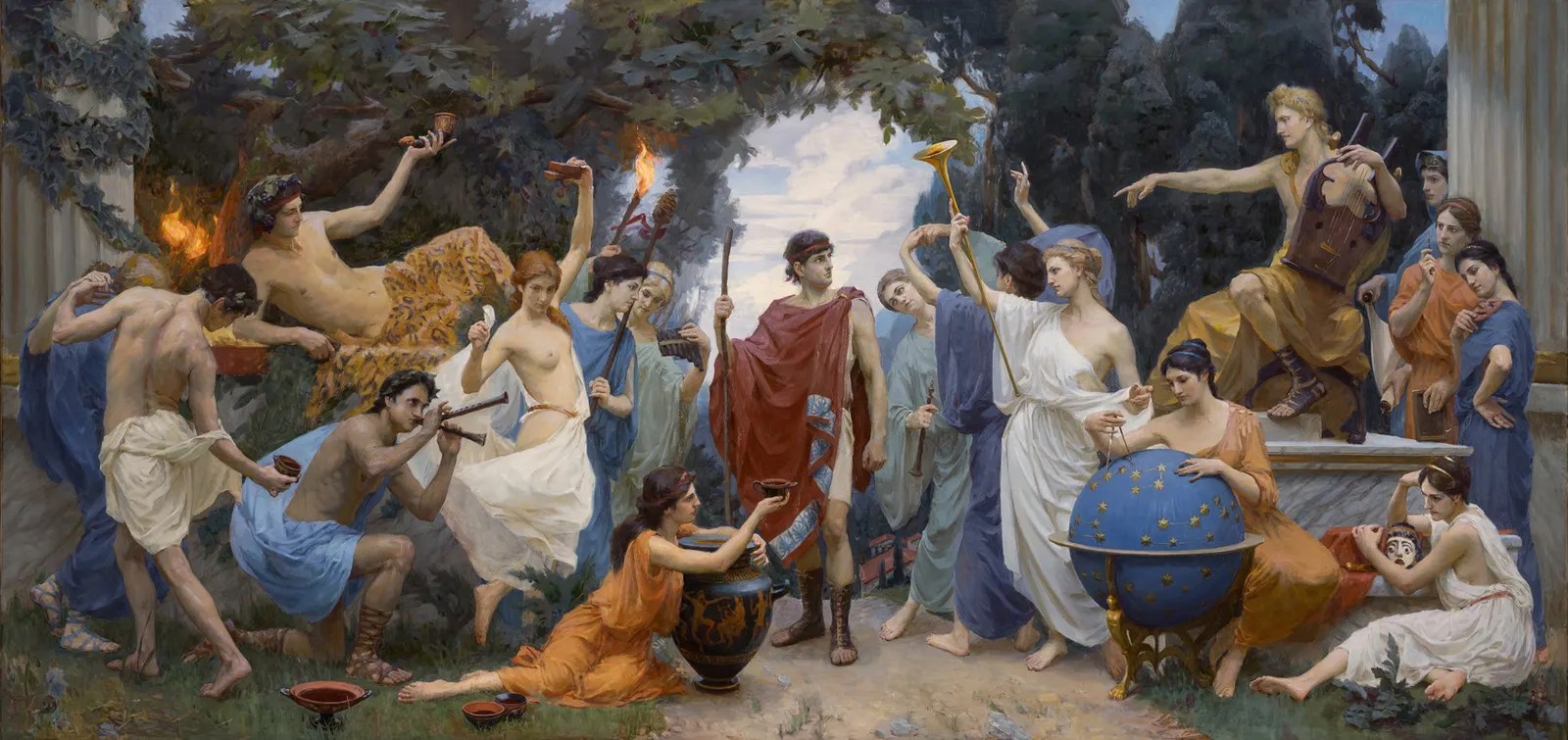
The book opens with the argument by defining two competing but complementary impulses in Greek Culture – the Apollonian and Dionysian. The Apollonian takes its name from Apollo, the god of light, dream, and prophecy, while the Dionysian takes its name from Dionysus, the god of wine and intoxication. In simple terms, Apollo is associated with visible form, rational knowledge, and moderation. Dionysus is associated with formless flux, mysticism, and excess. But the world of Apollo is made up of distinct moral individuals, while Dionysus presides over the dissolution of individual identity into a universal spiritual community uniting human beings with nature. He says: Apollo stands before me as the transfiguring genius of the principium individuationis, through which alone true redemption in appearance can be attained, while under the mystical cry of exultation of Dionysus the spell of individuation is burst apart and the path to the Mothers of Being, to the innermost core of things, lies open.
“Dionysian shows itself, in comparison with the Apollonian, as the eternal and original power of art, which calls the whole world of phenomena into existence: in whose midst a new transfiguring appearance becomes necessary in order to keep alive the busy word of individuation. If we could imagine dissonance in human form – and what is man but that? – then this dissonance, in order to be able to live, would need a magnificent illusion to cast a veil of beauty over its own essence. This is the true artistic intention of Apollo, whose name summarizes all those countless illusions of beautiful appearance, which in each moment make existence worth living and compel us to live on to experience the next moment.”
For Nietzsche, the world that we experience is a world of representations, one step removed from the world of will, which is the essence of being. If we now relate his view to the discussion of art, it is clear that representational art can only imitate the world we perceive and so provide representations of representations; in artistic terms, Apollo is the god of the forms, or the representational arts of painting, poetry, and sculpture, and has a strong association with architecture. On the other hand, Dionysus – the deity that represents another force is the god of intoxication in the world of will: that is, completely hidden underneath the ultimate reality, where only Music is a non-representational art that will have a complete bypass of the world of representation and offers us direct, unmediated access to the will.
In philosophical terms, it is thus by far the most important of the arts. This view of the philosophical significance of music is a direct link for us to understand more from the perspective of Nietzsche’s view on tragedy. Because Music, Nietzsche says, “Unlike all the other arts, is not a copy of the phenomenon but an unmediated copy of the will itself, and so represents the metaphysical in relation to the whole physical world and thing in itself in relation to the phenomenal world. On this most important insight of aesthetics, which, in a more serious sense, represents the beginning of all aesthetics.”
The influence of Arthur Schopenhauer plays a significant role in Nietzsche’s philosophy. The contradiction between the Apollonian and Dionysian begets the idea from Schopenhauer’s The World as Will and Representation. The emphasizing of the importance to music received philosophical justification in the work of Arthur Schopenhauer. For Schopenhauer, music possessed an ontological significance – unlike other, more superficial arts, it revealed truths about the nature of being – the thing in itself. But the key to understanding Schopenhauer’s interpretation of music also lies in his elaboration of two notions which beget from the other German philosopher – Immanuel Kant. In the Critique of Pure Reason, Kant argues that the empirical world available to our senses is merely a world of phenomena (Erscheinung), while the true essence of things, the things in themselves (Ding an sich), remains beyond our perception – thus Kant’s phenomenon becomes Schopenhauer’s presentation (Vorstellung), while Kant’s thing in itself is identified by Schopenhauer as Will (Wille).
But the folk song represents for us in the very first instance a musical mirror of the world, an original melody, which now seeks a parallel phenomenon in dream and expresses this in poetry…..only possible relationship between poetry and music, word and sound: the word, the image, the concept seeks an expression analogous to music and now feels the force of music in itself.
According to Nietzsche, music is regarded as the highest form of art, manifested directly from the will. Following Schopenhauer, he sees music as differing from all other arts in that it is not a copy of phenomena or, more accurately, of the objectivity of the will, but an unmediated copy of the will itself, and therefore represents the metaphysical in relation to the whole phenomenal world. This also explains why music allows every picture, indeed every scene of life and the world, to stand out with greater meaning.
He says: “They represent in the certainty of reality what music expresses in the universality of pure form. For melodies are, as it were, like all universal concepts, an abstractum of reality.” Ultimately, music is accordingly viewed as the expression of the world—a universal language to the highest degree—which, he thinks, bears roughly the same relationship to the universality of concepts as concepts bear to individual things.
Thus, following Schopenhauer’s doctrine, Nietzsche writes: “Dionysian art usually exercises two types of influence on the Apollonian capacity for art: music stimulates the allegorical contemplation of Dionysian universality, and music allows the emergence of the allegorical image in its most significant form.” Thus, to glimpse the deeper essence beneath appearances, the Dionysian force of intoxication must break through the boundaries of individuality; then the Apollonian force of art gives that overwhelming experience form, image, and beauty. Their union allows tragedy to reveal a kind of metaphysical joy even through suffering and destruction.
Therefore, Nietzsche thinks, under the overwhelming force of the Dionysian, man is no longer merely an artist; he himself has become a work of art. Through the subsequent reconciliation with the Apollonian force, the artistic power of the whole of nature reveals itself in form and image: the original Unity manifests itself through the shudder of intoxication, reaching its most intense and blissful satisfaction.
In the course of the argument, it has become the linchpin idea of the book, where the contradiction of Dionysian and Apollonian shifted into a different dimension– Aesthetic Socratism. Both the elements of the Dionysian and Apollonian drives no longer lie within the sphere of these two parallel forces. Instead of the Apollonian visions – and fiery emotions – in the place of Dionysian raptures–and they really are highly realistic imitations of thoughts and emotions devoid of any trace of the ether of art. For Nietzsche, the appearance of Euripides marks the beginning of the end for Greek Tragedy. Because the rise of aggressive Rationalism will ultimately undermine the mythical basis of tragedy and so destroy it.
Who is this man who single-handedly dares to negate the Greek character, which in the form of Homer, Pindar, and Aeschylus, of Phidias, Pericles, Pythia, and Dionysus, as the deepest abyss and the highest peak, is assured of our astonished adoration? What daemonic power is this which dares to spill this magic potion in the dust? What demigod is this, to whom the ghostly chorus of the noblest of humanity must shout: ‘Woe! Woe! Your powerful fist has destroyed the beautiful world; it collapses, it falls apart!
Because with this expression, Socratism condemns existing art as much as existing ethics: wherever it turns its searching gaze, it sees the lack of insight and the power of delusion and deduces from this lack the essentially perverse and reprehensible character of what exists. Thus, Apollo gives suffering a beautiful form in poetry, sculptures, imagery. Socrates demands that suffering give a rational explanation of itself. From here, we can approach the essence of Aesthetic Socraticism: ‘In order to be beautiful, everything must be intelligible’; as a counterpart to the ‘Socratic principle of “Knowledge is virtue”. With this doctrine, Euripides measured all the individual elements of drama in the Greek tragedy and rectified them accordingly: language, characters, the dramatic structure, the music of the chorus. Because Nietzsche thinks, Euripides did not treat the effect of tragedy as based on epic suspense, on the stimulating uncertainty of what will happen now and afterwards: but rather on those great rhetorical-lyrical scenes in which the passion and the dialectic of the protagonists swelled up into a broad and powerful torrent – everything served to enhance not the plot but pathos!
Consider the consequences of the Socratic principles: ‘Knowledge is virtue; sin is the result of ignorance; the virtuous man is the happy man’: in these three basic forms of optimism lies the death of tragedy. For now the virtuous hero must be a dialectician; now there must be a necessary visible link between virtue and knowledge, belief and morality; now Aeschylus’ solution of transcendental justice is degraded to the shallow and impudent principle of ‘poetic justice’ with its usual deus ex machina.
According to Nietzsche, it is this optimism dialective drives Music out of tragedy with the whip of its syllogisms: that is, it destroys the essence of tragedy, which can only be interpreted as a manifestation and transformation into images of Dionysian states, as visible symbolization of music, as the dream-world of a Dionysian intoxication. For this, he thinks the Socratic culture destroyed the myth and tragedy in the name of reason and science, thus preparing the advent of the next phase of Greek civilization. Here, Nietzsche did not demean the rise of science and the reason to look beyond things in themselves with logic. For it would be no science if science were only concerned exclusively with that single naked goddess. But what concerns him is the limitation of science, where it leads into the deepest empty abyss of human existence without meaning. But instead, he warns about the limitation of logic and reason.
He says:“The man elevated above the fear of death through knowledge and reasoning is the heraldic shield hung above the entrance gate to science in order to remind everyone of its purpose, namely to make existence appear intelligible and so justified: and, if reasons prove insufficient, even myth finally serve this end, myth which I have just characterized even as necessary consequence, indeed as the intended goal of science. “
Because, for Nietzsche, attempts at a scientific and objective historiography effectively suppress the vitality of the past, fail to discriminate between the value of different cultures, and lead ultimately to an endless empty cataloguing of past culture and events. He says: “Modern man begins to sense the limits of that Socratic delight in knowledge, and in the middle of that wide and desolate expanse of the sea of knowledge longs for land. Thus, to follow the doctrine of Kant and Schopenhauer, he argues that:
“The wisdom of Kant and Schopenhauer succeeded in winning the most difficult victory over the optimism which lies hidden in the essense ig logic, the optimism which is also the substratum of our culture…..had believed that all enigmas of the world could be known and fathomed, and had treat space, time, and causality as utterly absolute laws of the most universal validty, Kant revealed how all these only really served to elevate the mere phenomenon, to the status of the single and highest reality and to put it in the place of the innermost and true essense of things, thereby making real knowledge of the latter impossible, that is accordin to an expression of Schopenhauer’s, lulling the dreamer into a deeper sleep.”
Thus, he argues, to fill the enigma of life, of human existence. Art (Tragedy) must come in as consolation, particularly Music that manifests from the will. Hence, history should be celebrated in Myth, because myth protects us from music, while, on the other hand, myth alone gives music its highest freedom. For that reason, music in turn lends tragic myth a penetrating and persuasive metaphysical significance which word and image could never achieve without that unique help. At bottom, the relation between drama and music is precisely the opposite: music is the real idea of the world; drama is only the reflection of this idea, its isolated shadow image. So, to quote Nietzsche:
Tragic myth is to be understood only as a transformation of the wisdom of Dionysus into images through the artistic means of Apollo; the myth pushes the world of phenomena up against its limit where it negates itself and seeks to flee back into the womb of the one true reality.

