

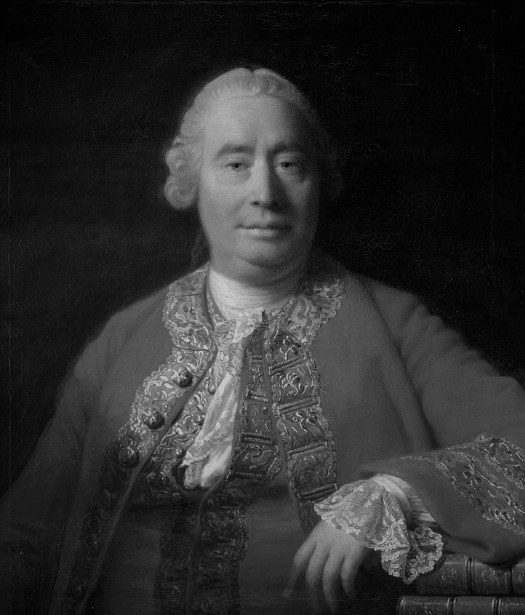
“When we run over libraries, persuaded of the principles, what havoc must we take? If we take in our hand any volume of divinity or school metaphysics, for instance, let us ask – Does it contains any experimental reasoning concerning matter of fact and existence? No. Commit it then to the flames, for it can contain nothing but sophistry and illusion.”
I guess Hume starts out, like John Locke, with the intention of being sensible and empirical, taking nothing on trust but senses knowledge. For him, there’s no reason for studying philosophy, except that, to certain temperaments, this is an agreeable way of passing time, it is ought only to be upon our skeptical principles, and from the inclination of whatever we feel to be employing ourselves after that manner. Taking John Locke’s “Blank Slate” (Tabula Rasa) as a foundation in empiricism school of philosophy to further on the inquiry of human’s conception of understanding. He arrives at the absurd conclusion that nothing that from experience and observation can be true and learned; whatever that concerns in “matter of fact” is nothing exact, but only our impression that we thought we know the cause of things.
He says: “We are determined by custom alone to suppose the future conformable to the past. When I see a billiard-ball moving toward another, my mind immediately carried by habit to the usual effect and anticipates my sight by conceiving the second ball in motion.” We normally would anticipate our sight and infer a conclusion that suitable to our past experience. From this, it follows that all reasonings concerning cause and effect are founded on experience and that all reasonings from experience are founded on the supposition that the course of nature will continue uniformly the same. So, nothing can be known to be the cause of another but by experience. We can give no reason for extending to the future our experience in the past but are entirely determined by custom when we conceive an effect to follow from its usual cause. Therefore, Belief in all matters of facts arises only from custom and is an idea conceived in a peculiar manner.
To account for this, Hume says there are only two hypotheses. It may be said that belief joins some new ideas to those which may conceive without assenting to them. First, there’s no such idea can be produced. When we simply conceive an object, we conceive it in all its parts. We conceive it as it might exist, though we do not believe it to exist. We may paint out the entire object in imagination without believing it. Second, the mind has a faculty of joining all ideas together which involve not a contradiction, and therefore, if belief consisted in some idea we add to the simple conception, it would be in a man’s power, by adding this idea to it, to believe anything which he can conceive. For this, he proves by its influence on the passions and on the imagination, which is only moved by truth or what is taken for such, therefore, belief merely consists of a peculiar feeling or sentiment in custom which is the guide of life, not reason. For this, he says: “For as it is by means of thought only that anything operates upon our passions, and as these are the only ties of our thoughts, they are really to us the cement of the universe, and all the operations of mind must, in great measure, depend on them.” Modern psychologist, Daniel Kahneman, notable for his work on the psychology of judgment and decision-making which I think has so much reminiscent with David Hume’s An Abstract of A Treatise of Human Nature that human cognitive bias is an insoluble phenomenon since the time of René Descartes skeptical doubt in human’s understanding.
“The feelings of our heart, the agitation of our passions, the vehemence of our affections dissipate all its conclusions and reduce the profound philosopher to a mere plebeian.”
For Hume, a philosopher who purposes to only represents the common sense of mankind in more beautiful and more engaging colors, if by accident he falls into error, goes no farther; but, renewing his appeal to common sense and the natural sentiments of the mind, returns into the right path and secures himself from any dangerous illusions. For those who find indulgement in abstruse philosophy cannot enter into business and action, vanishes when the philosopher leaves the shade and comes into open day, nor can its principles easily retain any influence over our conduct and behavior. And the abstruse philosophy seems hitherto to have enjoyed only a fraction of momentary reputation, from the caprice or ignorance of their own age. This is the part which I find David Hume is such a modernistic mind and way ahead of his contemporary philosophers. The only solution, Hume thinks, is the method of freeing learning at once from these abstruse questions is to inquire seriously into the nature of human understanding and show, from an exact analysis of its power and capacity, that is by no means fitted for such remote and abstruse subjects. He thinks, accurate and just reasoning is the only catholic remedy fitted for all persons and all dispositions and is alone able to subvert that abstruse philosophy and metaphysical jargon which, being mixed up with popular superstition, renders it in a manner impenetrable to careless reasoners and gives it the air of science and wisdom.
Besides, Hume’s modernistic mind and his peculiar inquiry on human’s nature and understanding has profoundly altered the subsequent thinkers and scientist on their works. In section IX, “Of the Reason of Animals”, Hume brings forth a very refreshing perspective on human cognitive with animals to draw a reference of studies on human and animal species before the time of Charles Darwin’s Origin of Species that shocked the science community and modern world. He goes on with: “All our reasonings concerning matter of fact are founded on a species of analogy which leads us to expect from any cause the same events which we have observed to result from similar causes…..Where the causes are entirely similar, the analogy is perfect, and the inference drawn from it is regarded as certain and conclusive….though still, it has some force, in proportion to the degree of similarity and resemblance.” First, he draws the fact that animals, learn many things from experience and infer that the same events will always follow from the same causes. For he thinks, the ignorance and inexperience of the young are here plainly distinguishable from the cunning and sagacity of the old, who have learned, by long observation. Secondly, he thinks, animals can’t be founded on any process of argument or reasoning by which he concludes that like events must follow like objects, and that course of nature will always be the same. Animals, therefore, are not guided in these inferences by reasoning; neither are children; neither are the generality of mankind in their ordinary actions and conclusions; neither are philosophers themselves, who, in all the active parts of life, are in the main the same with the vulgar and are governed by the same maxims. He concludes that it is custom alone which engages animals, from every object that strikes their senses, to infer its usual attendant, and carries their imagination from the appearance of the one to conceive the other in that particular manner which we denominate “Belief”. This fascinating analogical reasoning which concerns on human understanding on the matter of fact has profoundly changed the course of the subsequent psychology scientist but also biologists who think a human has no genetical difference than our ancestor Homo species. At last, Hume somehow draws a very careful line between forming a dogmatic conclusion and a meticulous hypothesis, he says:
“These analogical observations may be carried further, even to this science which we are now treating; and any theory by which we explain the operations of the understanding or the origin and connection of the passions in man will acquire additional authority if we find that the same theory is requisite to explain the same phenomena in all other animals. We shall make a trial of this with regard to the hypothesis by which we have, in the foregoing discourse, endeavored to account for all experimental reasonings, and it is hoped that this new point of view will serve to confirm all our former observations.”
In this book, I guess Hume’s skepticism rests entirely upon the rejection of the principle of induction reasoning which metaphysician and rationalist philosophers have been using it as a tool in their abstruse philosophy to confuse general people. What Hume is concerned with is uncertain knowledge, such as obtained from empirical data by inferences that are subjective. This includes all our knowledge as to the future, and as to unobserved portions of the past and present. In the book, “History of Western Philosophy” by Bertrand Russell, Russell thinks Hume’s skepticism on the skeptical conclusions are the reason for the growth of unreason throughout the nineteenth century and what has passed of the twentieth is a natural sequel to Hume’s destruction of empiricism. Because of the ultimate outcome of Hume’s investigation of what passes for knowledge is not what we suppose him to have desired. It is evident that he started out with a belief that the scientific method yields the truth, the whole truth, and nothing but the truth; he ended, however, with the conviction that belief is never rational since we know nothing.
To this extent, Russell thinks Hume has proved that pure empiricism is not a sufficient basis for science. And Russell thinks if we must be granted that this principle is admitted, that all the knowledge derived from experience is impossible to obtain which is a serious departure from pure empiricism. Without this principle, Russell thinks science would be impossible. However, I personally think the analysis of such ‘probable’ knowledge leads to the conclusion of skeptical doubts is a challenge to philosophers, which, has still not been adequately met. But, in my opinion, I guess too much knowledge will only lead to skepticism, but meanwhile, skepticism, which I think, is an essential element to cultivate one intellectual mind for critical thinking to doubt particular dogmatic and cherish belief in religion and social norm. Especially to learn the value of suspending judgment. Just as Hume says: “The most perfect character is supposed to lie between those extremes: retaining an equal ability and taste for books, company, and business; preserving in conversation that discernment and delicacy which arise from polite letters; and in business, that probity and accuracy which are the natural result of just philosophy.”
“Indulge your passion for science, but let your science be human and such as may have a direct reference to action and society. Abstruse thought and profound researches should prohibit and will severely punish by the pensive melancholy which they introduce, by the endless uncertainty in which they involve you, and by the cold reception your pretended discoveries shall meet with when communicated. Be a philosopher, but, amidst all your philosophy, be still a man.”
– David Hume

