
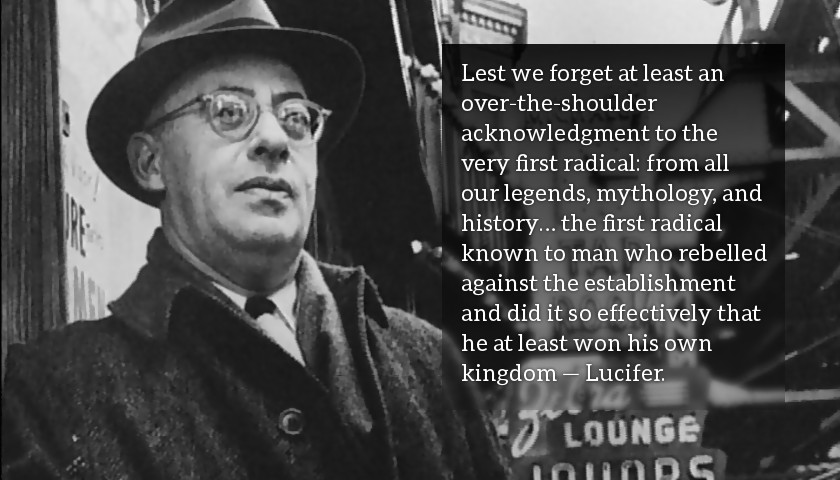
The Prince was written by Machiavelli for the Haves on how to hold the power. Rules for Radicals is written for the Have-Nots on how to take it away!
Unlike the book “Prince” by Niccolo Machiavelli . This is a book that addresses those who sought after power, power to reform, power to change the status quo, and power to challenge authority. A book to summon power with radical changes and ideas. The book must be read prudently and considered thoroughly with deep pondering of each idea and tactic by Alinsky.
If you look into the book review comments, most of the ratings can be differing radically. Some 5 stars, some 1 stars rating, or even worse– despite the ideas of Alinsky. I am guilty to say, I am the one who adheres to Alinsky’s ideas and the concepts of power. His work is pragmatic, or even realistic. He dislikes Utopian thinking which he thinks is a sign of hallucinations that we humans tend to rationalize when we are unable to achieve the ends. Just as he says in the book:
This is not an ideological book except insofar argument for change, rather than for the status quo, can be called an ideology; different people, in different places, in different situations, and at different times will construct their own solutions and symbol of salvation for those times.
He even distinguished his work from the ideology of Marxist communism where most radical revolutionists based only on the language of the communism handbook. There, they read about tactics, maneuvers, strategies, and principles of action-making revolutions. As he says: This is a major reason for my attempt to provide a revolutionary handbook not cast in a communist or capitalist mold, but as a manual for the Have-Nots of the world regardless of the color of their skins or their politics. My aim here is to suggest how to organize for power: how to get it and to use it.
It is paradoxical that the affirmation of Alinksy that he dislikes ideology as he asserted. But he advocates The Ideology of Change for those who ought to know how to reform and be able to discern the circumstances. He starts with:
To begin with, he does not have a fixed truth–truth to him is relative and changing; everything to him is relative and changing…..He must constantly examine life, including his own, to get some idea of what it is all about, and he must challenge and test his own feelings. Irreverence, essential to questioning, is a requisite. Curiosity becomes compulsive. His most frequent word is “why?”
For this ideology of change has very similar to the Chinese metaphysical view in Daoism. He says: “It is the universal struggle between the positive and its converse negative, which includes the reversal of roles so that the positive of today is the negative of tomorrow and vice versa… A beautiful positive dream has grown into a negative nightmare… Seeing everything in its duality, we begin to get some dim clues to direction and what it’s all about. It is in these contradictions and their incessant interacting tensions that creativity begins.” This is not a fresh concept for me, but it seems relative to my current political and metaphysical view. A view that is embodied in me since Heralictus’s work and the subsequent thinkers that altered my worldview. But he thinks, as an organizer, it is crucial to recognize the pattern and to be able to fluidly adjust his own feelings, an ideology based on the circumstances, and leverage the popular view that is grounded on the majority demand to gain power.
Just like every pragmatist will do, the ends always justify the means. It is the central idea of his political maneuver and ethical philosophy. He says: “To me ethics is doing what is best for the most.” It might not digestible for most the readers, but he says in a political war situation, the end justifies almost any means. Because he thinks, as he quotes Goethe‘s word, “Conscience is the virtue of observers and not as of agents of action”; in action, one does not always enjoy the luxury of a decision that is consistent both with one’s individual conscience and the good of mankind. He thinks the men who pile up the heaps of discussion and literature on the ethics of means and ends–which with rare exception is conspicuous for its sterility–rarely write about their own experiences n the perpetual struggle of life and change.
One of the interesting parts that caught my attention is how he defy Niccolo Machiavelli’s moral view on the political situation. He says: “Moral rationalization is indispensable at all times of action whether to justify the selection or the use of ends or means. Machiavelli’s blindness to the necessity for moral clothing to all acts and motives–he said “politics has no relations to morals”–was his major weakness.” Now is interesting and novelty to me, he even cites the fact that most of the political reformer leverage the moral value of the public to gain “power” and supports from the majority for revolution. For instances, he says, all great leaders, including Churchill, Gandhi, Lincoln, and Jefferson, always invoked “moral principles” to cover naked self-interest in the clothing of “freedom” “equality of mankind”, “a law higher than man-made law”, and so on.
As the book goes on, the significant emphasis on power becomes redundant, and I started to drift off myself along the way when I’m reading. Not that I do not agree with his ideas, but allegedly I am already buying into all of his ideas totally without prejudice. There’s another idea of Alinsky that I find resonating which is the idea of conflict. He thinks Conflict is a word that has been badly perceived in general opinion. I do not want to discuss what’s his extrapolation on why the general opinion misperceived the word conflict but his idea on conflict. For him, new life, a new idea, or even a new society is an essential element to arise from conflict. He says:
Conflict is the essential core of a free and open society. If one were to project the democratic way of life in the form of a musical score, its major theme would be the harmony of dissonance.
This notion of conflict has reminiscent of the book Antifragile written by one of my favorite authors, Nassim Taleb. The basic foundation of society is a constant flux and chaos where ideas and inventions arise from conflict or friction. It is a natural phenomenon even in mother nature where Alinsky explains his proposition further with: It is the universal tale of revolution and reaction. It is the constant struggle between the positive and its converse negative, which includes the reversal of roles so that the positive today is the negative of tomorrow and vice versa. It is a book that is meant to be read and pondered. My commentary on this book is just an oversimplification of Alinsky’s ideas, I suggest reading, finding contradictions in it, and pondering deeply about the contradiction and ideas. I think one must be learned is to defy the belief system that embodies in our minds, to find the struggles, and the dissonance of the ideas and connect them together with new ideas, and lay them out coherently with a map for new directions to point to. At last, I would just like to drop a quote from the book to end my comments:
General theories become meaningful only when one has absorbed and understood the specific constituents and then related them back to the general concept. Unless this is done, the specifics become nothing more than a string of interesting anecdotes.
Thank you for reading!

