
Ahh… Love. The unsolved mysteries for centuries. Ever since the human being existed, we are revolving around the topic of Love and praise it with drama, poems, music, arts, and movies. It seems we are still in the way of searching the true definition of Love.
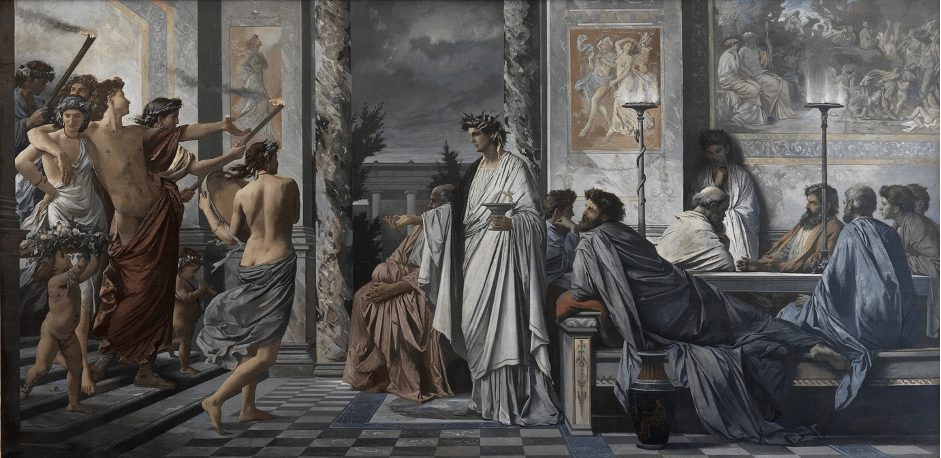
In the book of Plato’s Symposium, there are a bunch of intellectuals who gathering in Agathon’s house for his celebration of winning in the poetry competition. And they decided each person at the symposium agrees to make a speech in praise of love, or, more precisely, Love of Eros, as a god. The most important speech of all, I think is the dialogue of Socrates with Diotima that philosophize about love and how his speech alludes to, modifies or corrects those speeches by others and this way he suggests that Diotima had provided some access to the truth of love that make it a perennial classic.
Speech of Socrates with Diotima
“But you’ve agreed that it’s because Love is in need of good and beautiful things that he desires those very things that he needs.” “Yes, I’ve agreed to that.” “So how could he be a god if he is not in possession of beautiful and good things?” “That’s impossible, as it seems.” “Do you see, then,” she said, “that you don’t believe Love is a god?” “But what could Love be?” I said. “A mortal?” “Far from it.” “What then?” “Like those examples discussed earlier,” she said, “he’s between mortal and immortal.” “He is a great spirit, Socrates. Everything classed as a spirit falls between god and human.”
The point of Diotima is to explain that love is a spirit to carry the message from humans to gods and from gods to human. Being intermediate between the other two, they fill the gap between them and enable the universe to form an interconnected whole. There are many spirits, of very different types, and one of them is Love. Which I think this is how Plato explain his Theory of Froms through the dialogue of Socrates between Diotima.
“Because he is the son of Resource and Poverty; he’s always poor; far from being sensitive and beautiful, as in commonly supposed, he’s tough. He always sleeps rough, on the ground, with no bed, lying in doorways; sharing his mother’s nature, he always lives in a state of need. On the other hand, taking after his father, he schemes to get hold of beautiful and good things. He’s brave, impetuous and intense; a formidable hunter always weaving tricks; he desires knowledge and is resourceful in getting it; a lifelong lover of wisdom; clever at using magic drugs and sophistry.”
This point is illustrated by a myth depicting Love as a product of a sexual encounter between Poverty and Resource: Love is always poor and in a state of need but he is also resourceful in finding ways to satisfy his need. This form a transition to the idea of Love not as wise but as a lover of wisdom or philosopher.
“Why is Love of beautiful things? or, to put it more clearly, the lover of beautiful things has a desire – What is it that he desires?” ……”In essence, every type of desire for good things or happiness is what constitutes, in all cases, ‘powerful and treacherous love’. But this can be approached by many routes, and those who do so by other means, such as making money or athletics or philosophy, aren’t described as ‘loving’ or ‘lovers’. It’s only those whose enthusiasm is directed at one specific type who is described by the terminology that belongs to the whole class, that of love, loving and lovers.”
From here, Diotima explains the underlying motive of love. The lover’s love of beauty is an expression of the general human desire to gain possession of good things and so to be happy. In fact, she redefines the meaning of ‘love’, saying that love is essentially a desire for happiness. She also draws on more general meaning to clarify the motivation of the impulse we do normally call love. She also shows different kind of motivation is at work in other forms of human activities which we do not normally associate with love, for instance, in pursuit of fame and wealth, or poetry and philosophy.
“It is to achieve immortality that everything shows this enthusiasm, which is what love is.”
Diotima restates that the overall goal of love is being possession of good things forever. She redefines the purpose of love as giving birth in beauty both in body and mind. The point made about humans applies to animals; mortal nature does all it can to live forever by reproduction. This applies not only the body but mind: attributes, character-traits, belief, desires, pleasures, pains, and also knowledge. This distinction recalls Pausanias’distinction between Heavenly and Common Love. There is, however, the significant difference that, lover’s motivation is directed only to make the loved one better and not physically gratification. The ethical improvement of the loved one is described as the means by which the lover can immortalize himself through the mental ‘children’ produced by their relationship which the generally described it as “Platonic Love”.
At last, the ultimate objective of love described by Diotima is the type of beauty that unmistakably suggests what is generally called Plato’s ‘Theory of Forms’. To reach an understanding of this Form is to understand what beauty really is, as an objective reality, by contrast with our normally partial and localized grasp of beauty. “First, this beauty always is, and doesn’t come into being or cease; it doesn’t increase or diminish. Second, it’s not beautiful in one respect but ugly in another, or beautiful at one time but not at another, or beautiful in relation to this but ugly in relation to that; nor beautiful here and ugly there. Nor will beauty appear to him in the account or piece of knowledge; or as being anywhere in something else, for instance in a living creature or earth or heaven or anything else. It will appear as in itself and by itself, always single in form; all that, when other things come to be or cease, it is not increased or decreased in any way nor does it undergo any change. When someone goes up by these stages, through loving in the correct way, and begins to catch sight of that beauty, he has come close to reaching the goal.” A possible response to this question is that Diotima’s main aim is to give a general account of human desire (or love) in an extended sense. The mysteries suggest that philosophically based knowledge of the Forms provides the best possible route to human happiness and thus the highest form of ‘love’. The passage with its ambiguous language, allow scope for various possible ways of reaching this goal. Perhaps the ascent also can be made without any involvement of interpersonal love at all. In this respect too, it also underlines the general Platonic theme that philosophical inquiry consists in a continuing search for knowledge of objective truth rather than in its achievement.
Conclusion
Quote the words from Montaigne: “If you press me to say why I loved him, I can say no more than because he was he, and I was I.” At the end of this book, Plato seems to advocate a kind of mysticism —a sort of erotic love-affair with the divine that alienated most of the general people who have a general perception in love (including me). For those who actually in love which I found that the eulogy of Pausanias and the distinction of love between Heavenly Love and Common Love seems much closer to the truth. Common Love is purely physical; Heavenly Love is also physical, but it is only aroused by those who are capable of rational and ethical development. But Plato’s Form of Beauty makes Pausanias emphasize, rather, the lover’s concern with physical gratification, by contrast with loved one concern with his ethic development beyond the realm of reality. Regardless of the advocation of Sufi-mystic for the affair with the divine. The spiritual of Socrates inquiry about love, Plato’s dialogue are valuable even if we disagree with this abstract theory. So my suggestion is, read, and re-read again; ponder and meditate and pose our own reflection. Likewise, the purpose of Diotima’s philosophize about Love. It is the continuing search for the truth that matters not its achievement.

