
Philosophy of Logical Analysis
Unless words, to some extent, had fixed meanings, discourse would be impossible. Words do change their meanings; take, for example, the word ‘idea’. It is only by a considerable process of education that we learn to give this word something like the meaning which Plato gave to it. It is necessary that the changes in the meanings of words should be slower than the changes that the word describe, but it is not necessary that there should be no changes in the meaning of words. Perhaps this does not apply to the abstract words of logic and mathematics, but these words, as we have seen, apply only to the form, not the matter, of propositions.
Like every other philosopher, Bertrand Russell attempts to rescue philosophy away from obscurantism which confuses people and, in time, even affected the progress of humanity and progress of knowledge. Since the time of Pythagoras, there has been a dispute between the schools of philosophy which on one hand, who were more inspired by mathematics; on the other, those who were more influenced by the empirical sciences. Plato, Thomas Aquinas, Spinoza, Leibniz, and Kant belong to what we may be called the Rationalist who deeply inspired by mathematical knowledge. Aristotle, John Locke, David Hume, and the modern empiricists onwards belong to the opposite party.
Bertrand Russell believes that it gradually became clear that a great part of philosophy can be reduced to something that may be called philosophical ‘syntax’, though the word has to be used in a somewhat wider sense than has hitherto been customary. He thinks that all philosophical problem, is the problem of syntactical, and that, when errors in syntax are avoided, a philosophical problem might be solved or shown to be insoluble. As it seems, the linguistic error since the time of Plato’s universalism and Aristotle’s realism that clogged the field of metaphysics, which can be able to solve if every philosopher adopted the logical analysis as a basis for further discourse.
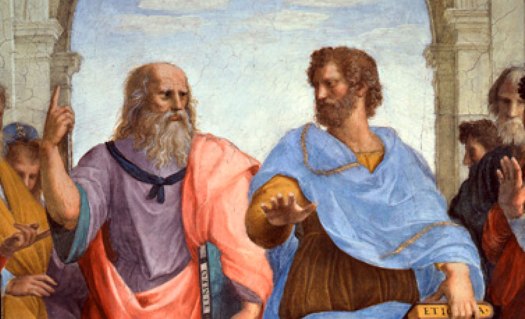
(Plato point the finger to the above as an indication of his philosophical doctrine that the ultimate reality is the other-world reality which is eternal, beauty and immutable. Aristotle holds his hand down, as it seems, an opposition of Platonic idea that the reality is the one that we see and experience)
There is, however, something of great importance in Plato’s doctrine which is not traceable to his predecessors, and that is the theory of ‘ideas’ or ‘forms’. Plato’s metaphysics rests on the distinction of reality and appearance. For instance, though there are many cats, there is only one ‘idea’ or ‘form’ of a cat. Just as a reflection of the cat in a mirror is only apparent and not ‘real’, so the various particular beds are unreal, being copies of the ‘idea’ which is the only one real cat. According to the metaphysical part of the doctrine, the word ‘cat’ means a certain ideal cat, ‘the cat’, created by God, and unique. Particulars partake of the nature of the cat, but more or less imperfectly; it is only owing to this imperfection that there can be many of them. From there, we get the inference that: ‘The cat’ is real; therefore the particular cats are only apparent in the world of appearance.
Metaphysicians, ever since Aristotle, have interpreted these syntactical differences metaphysically: John and James are substances, wisdom and folly are universals (forms or ideas). Russells writes, the problem of universals is concerned with the meaning of such words, and also of adjectives, such as ‘white’, ‘hard’, ’round’, and so on. By the term, ‘universal’ means that which is of such a nature as to be predicated of many subjects, by ‘individual’ that which is not thus predicated. For Aristotle, a substance is a ‘this’, but a universal is a ‘such’ – it indicates the sort of thing, not the actual particular thing. A universal is not a substance, because it is not a ‘this’. Aristotle says, “it seems impossible, that any universal term should be the name of a substance. For … the substance of each thing is that which peculiar to it, which does not belong to anything else; but the universal is common, since that is called universal which is such as to belong to more than one thing. The essence of the matter, so far, as it seems, that a universal cannot exist by itself, but only in particular things.”
The dispute between Plato and Aristotle’s metaphysics may be attributed to the facts that Aristotle’s own doctrine is far from clarity. It was this obscurity that made possible the controversy in medieval philosophy that ontological argument becomes an authoritative argument in logic between nominalists and realists. The theory of Aristotle’s theory of universals is not clear, but it is certainly an advance on the theory of ideas and is certainly concerned with a genuine and very important problem. The view that forms and substances, which exists independently of the matter in which they are exemplified, seems to expose Aristotle to his own arguments against Platonic ideas. A form is intended by him to be something quite different from a universal, but it has many of the same characteristics. The Form is, for Aristotle, more real than matter; this is reminiscent of the sole reality of the ideas. Russell thinks, that all the obscurity of philosophy might be solved if all the words of ordinary languages will have yielded to analysis, and been replaced by words having a less complex meaning. Until this labor has been performed, the question of particulars and universals cannot be adequately discussed. And when we reach the point at which we can, at last, discuss it, we shall find the question we are discussing is quite different from what we supposed it to be at the outset.
I do not think I am adequate enough to criticize the doctrine of the philosophy of logical analysis. But I personally think that, if we were, ready to adopt the logical analysis as a business for philosophy, there will be no more room for the discussion of love, moral, and aesthetics which Russell strongly disagree and working hard to abandoning it as a part of dogmatic pretensions.
Pragmatism
Pragmatism has always been an appeal to those unsophisticated minds, and it has also become a target attacked by those intellectuals, which they think it has a thoroughly unsatisfactory philosophical standpoint. For Russell, ‘Truth’ is a belief or nearly as true as it can make it if it has a certain kind of relation to its causes; he judges it by its causes where a past occurrence is concerned and to further investigate the causes. From the pragmatism standpoint, he finds the doctrine of truth from William James and John Dewey incomprehensible and intellectual difficulties. He thinks the doctrine of pragmatism is only a form of the subjectivistic madness which is characteristic of most modern philosophy.
From the above proposition, I would like to offer an apology for the philosophy of pragmatism. For the elite intellectuals, they always have some kind of fastidious and insatiable thirst for absolute and definite knowledge. My understanding of Pragmatism is a doctrine that focuses on the effect as a true belief basis for human endeavor. It is a process which aims at the individual search for the knowledge, that belongs to a certain field of epistemology. For instance, an entrepreneur would like to know whether or not his business should or should not be proceed based upon his research and investigate from the market. There are two choices which he can proceed, A) He can continue to research and investigate the market and to find the causes which determine the demand of the market. This would take a long time and relentless resources that eventually paralyze decision making. B) He could’ve acted upon probabilities based on his assumption and investigation, where I think, he should focus on the effect and consequences to prove his ‘Truth”.
Provided the above argument, I definitely think it would be outrageously unaccepted for those who appreciate knowledge as their treasure and find this argument absurd. Quote the words from Francis Bacon: “To spend too much time in studies is a sloth; to use them too much for ornament, is an affectation; to make judgment wholly by their rules, is the humor of a scholar.” The classification of philosophies is effected, as a rule, by their method or results: ’empirical’ and ‘analytical’ is a class of method, ‘realist’ and ‘idealist’ classed as a result from the method. Therefore, they would have a vast aspect of principles that lead the philosopher to philosophize. Theoretical people inspired by the love of knowledge; practical people, inspired by the love of action; sensitive people inspired by the aesthetical value. Ever since Seneca, Marcus Aurelius, and other Roman Stoics demean the theoretical philosopher who makes the logic splitting method and rhetoric as the main business of philosophy. Russell dislikes the doctrine from the school of pragmatism and advocating the logical-analysis as prime merit of the philosophical school, which I think, it is dogmatic at it seems which he has been trying to avoid all the time. My definition of ‘philosophy’ should be, and always be a source of inspiration; medication; retreats, consolation to suggest and inspire people a way of life whichever appeals to human reason.
To be continued…

