
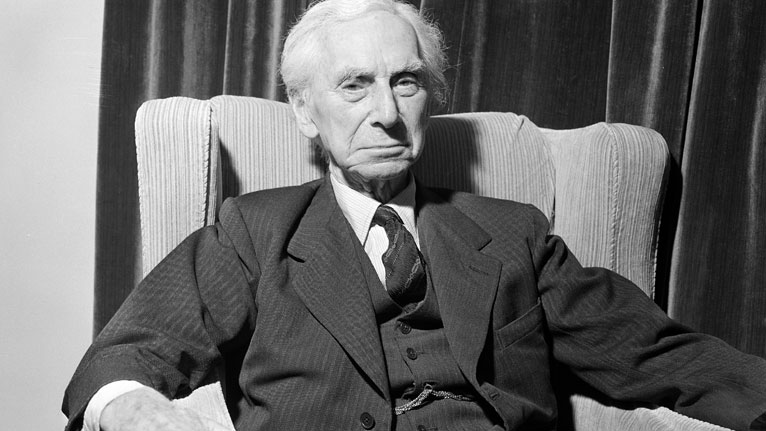
“All definite knowledge–so I should contend–belong to science; all dogma as to what surpasses definite knowledge belongs to theology. But between theology and science there is a No Man’s Land, exposed to attack from both sides; this No Man’s Land is philosophy.”
Thought-provoking and absolutely stunning. I got fascinated by Rusell’s writing throughout his opinionated philosophical view for other’s school of thoughts. In my opinion, I think one should at least grasp the context and notion of the western historical development of philosophy in order to comprehend what Bertrand Russell trying to put forth into his book. This book is an unrelenting critical analysis of western development of thoughts throughout the whole period, and it is–at it seems–an attempt by Russell to rescue philosophy from the rigidity and dogmatic arguments invented by scholastic schoolmen since the medieval ages.
“Philosophy” is a word which has been used in many aspects, some shallow, some in a deeper sense. Contemporary people treat philosophy as a subject that has nothing to do in real life matter; some people interpret it– as a way of life. For Russell, philosophy is something intermediate between theology and science. It consists of speculations on matters as to which definite knowledge has, so far, been unascertainable; but like science, it appeals to human reason rather than to authority and blind faith. At this point, I’m indubitable in concurring with his view. There is also, however, a more personal answer from the pursuit of philosophy. In the modern age, science tells us what is certain, but what we can know is little and what’s the remains is still very puzzling, and there’s an enigma which science is trying so hard to giving a certain answer. Take such questions as – What is Time? What is space? What is the number? What are the mind and soul? What is reality? The studying of these questions is not answering them, but it is the business of philosophy–just as Russell puts it this way:
“Uncertainty, in the presence of vivid hopes and fears, is painful, but must be endured if we wish to live without the support of comforting fairy tales. It is not good either to forget these questions that philosophy asks, or to persuade ourselves that we have found indubitable answers to them. To teach how to live without certainty, and yet without paralyzed by hesitation, is perhaps the chief thing that philosophy, in our age, can still do for those who study it.”
Apparently, there’s bias in every one of us, including Russell’s doctrine. In this book, it seems that he is trying to put forth his criticism among the idealist philosophers. It is a work that attempted to revolt against “Romantic Idealism” during his present time that Hitler’s Nazism and Totalitarianism in the Soviet Union got into the position of power. Social cohesion and individual liberty, as he thinks, like religion and science. It is always in a state of conflict and uneasy compromise throughout the whole period. Unlike Marxist idealism, where he instate that every social struggle is the struggle of the class. It is in the mode of production, as a driving force, that man’s relation of the matter is the cause to determine the social structures.
Of cause, in this view, Russell strongly opposed Karl Marx‘s doctrine that social causation largely ceases to apply as soon as a problem becomes detailed and technical. On the contrary, Russell thinks Marx has grave shortcomings that he is too practical, too much wrapped up in the problems of his time. For his part, he believes, there’s reciprocal causation in men’s lives and their circumstances that do much to determine their philosophy, but, conversely, their philosophy does much to determine their circumstances. He says: “Ideas, according to this view, are froth on the surface of deep currents, which are determined by material and technical causes: social changes are no more caused by the thought that the flow of a river is caused by bubbles that reveal its direction to an onlooker. I believe that the truth lies between these truth extremes. Between ideas and practical life, as everywhere else, there’s a reciprocal interaction; to ask which is cause and effect is as futile as the problem of the hen and the egg”.
From the above of Russell’s assertive prepositions, I can’t help, but find an inconsistency in his writing and his statement about the social causation. In the book, he relentlessly criticizes the subjective idealism of every philosopher that appeared as a leading figure in the Romantic Movement; primarily since the time of Pythagoras Orphism entered into the philosophy of Plato, and from Plato into the modern time of Rousseau’s romanticism that leads eventually to the philosophy of Nietzsche. He thinks that it is not the psychology of the romantics that is at fault: it is their standard values. Because they admire strong passions, of no matter what kind and whatever may be their social circumstances. But most of the strongest passions are destructive–hate and resentment and jealousy, despair, outraged pride, contempt for weak and cowards. It is these elements that we found in the philosophy of Nietzsche that, the “Noble-man (ubermensch)”, is the core of advocacy that influences the rise of German idealism, become solipsistic, and self-transcending as the fundamental principle of ethics.
We can discern from the analysis of Russell antagonistic view for Nietzsche, Rousseau, and the anti-intellectualism of modern romanticism that cumulated to the present catastrophic totalitarianism social structure is the products of the irrational egoistic passion of the individual aimed at liberating human personality from the fetters of social convention and social morality. He summarizes as below:
“Egoistic passions, when once let loose, are not easily brought again into subjection to the needs of society. Christianity has succeeded, to some extent, in taming the Ego, but economic, political, and intellectual causes stimulated revolt against the Churches, and the romantic movement brought the revolt into the sphere of morals. By encouraging a new lawless Ego it made social co-operation impossible and left its disciples faced with the alternative of anarchy or despotism. Egoism, at first, made men expect from others a parental tenderness; but when they discovered, with indignation, that others had their own Ego, the disappointed desire for tenderness turned to hatred and violence. Man is not a solitary animal, and so long as social life survives, self-realization cannot be the supreme principle ethics.”
Although I disagree with Russell’s speculation. Undeniably, I somehow think Russell attempt to look at the cause and effect of the social changes and the political affair is a way to interpret and understand in his view to make a sensible analysis that – general people should be better educated in facts, and a decent element of skepticism is required whenever we think that whatever reasons that seem appealing to us. In short: one should always behold their belief and act upon practicality and probabilities with a dose of skepticism, and there’s no shortcut to knowledge; and we ought to cultivate one modest intellectually without becoming too dogmatic. This is the lesson that I excerpt from his analysis.
The book itself is distinguished into 3 ‘books’. Book 1 mainly concerns with the pre-socratic natural philosophy that built a coherent group of thoughts that prepared the way for Plato and for the philosophical Schools of the following generations. Book 2 is the part where Russell dissect the cause of Catholic Philosophy and how the Neo-Platonism influences the rest of the Churches that bring philosophic belief into closer relation to social and political circumstances which affect the modern world. At last, Book 3 begins with the subject of philosophy of science and how the Corpenicus-revolution affected the rest of the modern thinkers and shifted their speculation of matters into a more scientific inquiry of nature and the world which became the special objects of astronomy, physics, chemistry, zoology, botany, psychology and so on, all these we might just count as ‘science’ in the modern term.
Bertrand Russell is a very profound and excellent writer, he can be able to analyze and summarize an abstract theory into a very common analogies explanation. He did not write like an academic which he prefers simple languages; he did not confuse people with too many jargons that makes people like me who does not shares the intellectual background. This is a very long and thick book that Russell constantly injects his philosophical view in every philosopher that he’s writing. If we want to approach it, I personally think we should start with his intention of writing this book. He is considered one of the founders of analytic philosophy, if we persist till the end of the book, we can be able to understand his ultimate intention, which he is trying to introduce the philosophy of logical analysis. Just like Russell, I sought to compromise, by eliminating the philosophical view of others school of thought that treated by Russell; I only treat those ideas that put forth in the book that it seems to me to have considerable importance to me and my connection with them. Otherwise, I think the reader should dive deeper into his book and look for the gold nuggets themselves.
At last, I would like to further my writing regarding the philosophical view of Russells that I have agreed and disagree with; in the next part of my essays. The treatise which will only concern the part that; profoundly alter my view on the nature of science and philosophy. Second, my apology for the school of pragmatism which focuses on the epistemic responsibilities that affected people’s lives. Third, the merit of Russell’s attempt to clarify the notoriously difficult of Hegel’s philosophy, and the introduction of the school of logical-analysis philosophy. Last, which Russell’s notion on the Skepticism in philosophy that I think is an essential element to cultivate one’s intellect.
To be continued…

