
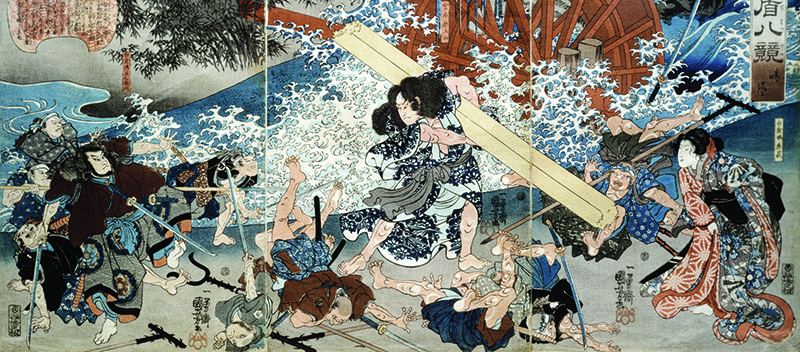
In 1605, Miyamoto Musashi, a lone samurai who had made a name for himself as a swordsman at the young age of twenty-one. He spent his time traveling and engaging in duels, such as with an adept called Akiyama from the Tajima Province. Musashi is said to have fought over 60 duels and was never defeated, although this is a conservative estimate, most likely not accounting for deaths by his hand in major battles. Musashi created and refined a two-sword kenjutsu technique called niten’ichi or nitōichi or “Niten Ichi-ryu”. In this technique, the swordsman uses both a large sword and a “companion sword” at the same time, such as a katana with a wakizashi. And in his final years authored The Book of Five Rings a book on strategy, tactics, and philosophy that is still studied today.
In the book “The 33 Strategies of War” by Robert Greene. He describes the reason of Miyamoto Musashi won all his duels for one reason: in each instance, he adapted his strategy to his opponent and to the circumstances of the moment. Musashi opponents depend on brilliant technique, flashy swords, and unorthodox weapons. This is the same as fighting in duels: instead of responding to the moment, they relied on training, technology, and what had worked before. Musashi, who grasped the essence of strategy when he was still very young, turned their rigidity into their weakness. The problem is that we imagine that knowledge is what was lacking: if only we had known more, if only we had thought it through thoroughly. A strategy is not a question of learning a series moves or ideas to follow a recipe; victory has no magic formula. Likewise, in life people always looking for a shortcut to the route of success, they look for something that is easy and cushy without any dedication or hustling. They look for advice from successful people, join all sort of seminar class and immersed themselves in their world of imagination toward the road of success.
The Book of Five Rings was written in 1643 where Miyamoto Musashi devoted his work to the art of war as a purely pragmatic enterprise. He decries empty showmanship and commercialization in martial arts, focusing attention on the psychology and physics of lethal assault and decisive victory as the essence of warfare. The basic principles of the teaching of him are always keeping inwardly calm and clear even in the midst of chaos and not forgetting about the possibility of disorder in times of order. He was obliged to practice both of these fundamental aspects of the way in mostly intensified manner, lending to his work a keenness and ferocity that can hardly be surpassed. The book is written in a manner of influenced by Buddhism and Confucianism thinking that makes Musashi become who he is. The book distinguished into five different courses named, The Earth Scroll, The Water Scroll, The Fire Scroll, The Wind Scroll and last one, The Emptiness Scroll.
The Earth Scroll
“When one has developed practical knowledge of all skills of the craft, eventually one can become a master carpenter oneself.”
At first, he likened the science of martial arts to carpentry. He describes people make the arts into commercial products; they think of themselves as commodities, and also make implements as items of commerce. He finds this attitude has less reality than decoration. There are four walks of life, of knights, farmers, artisans, and merchants. By likening the word of Carpenter is written with characters meaning “great skill” or “master plan”. Since martial arts involved great skill and master planning, he writing this comparison with carpentry.
“Master carpenter directs the journeymen, he knows their various levels of skill and gives them appropriate tasks. When the master exercise discernment in the assignment of jobs, the work progresses smoothly. Efficiency and smooth progress, prudence in all matters, recognizing true courage, recognizing different levels of morale, instilling confidence, and realizing what can be and cannot be reasonably expected, such are the master of the mind.”
In the Earth Scroll is an outline of the way of martial arts. He describes that the way of martial arts cannot be attained only by the mastery of swordsmanship alone. But even if they are not your path, if you have a wide knowledge of the ways, you encounter them in everything. In any case, as human beings, it is essential for each of us to cultivate and polish our individual path. Other than that, he describes rhythm is something that exists in everything, even in our daily life. Harmony and disharmony in rhythm occur in every walk of life. It is imperative to distinguish carefully between the rhythms of flourishing and the rhythms of decline in every single thing. Below is the teaching of Musashi rhythm to become a master of oneself:
1. Think of what is right and true.
2. Practice and cultivate the science.
3. Become acquainted with the arts.
4. Know the principles of the crafts.
5. Understand the harm and benefits in everything.
6. Learn to see everything accurately.
7. Become aware of what is not obvious.
8. Be careful even in small matters.
9. Do not do anything useless.
The Water Scroll
“Once you have sharpened your intellect to the point where you can see whatever in the world is true or not, where you can tell whatever is good or bad, and when you are experienced in various fields and are incapable of being fooled at all by people of the world, then your mind will become imbued with the knowledge and wisdom of the art of war.”
In the Water Scroll he taking water as the basic point of reference, one makes the mind fluid. Water conforms to the shape of the vessel, square or round; it can be a drop, and it can be an ocean. As the mind it’s the strongest weapon of warrior can have in the battle. Pay attention to the mind, not the body. Let there be neither insufficiency nor excess in our mind. Even if superficially weakhearted, be inwardly strong hearted, and do not let others see into our mind. He advocated people taking the principles of teaching into the heart as we discovered from our own mind, identifying with them constantly and work on them carefully to crafted our learning. As he mentioned, “Observation and perception are two separate things; the observing eye is stronger than the perceiving eye.”
The Fire Scroll
In the Fire Scroll, he describes we should observe reflectively, with overall awareness of the large picture as well as precise attention to small details. Think of the story of David & Goliath. People of the world all think of the principles of advantage in small terms. Instead of that, we should assess the knowledge and tactics of all adversaries, know the strengths and weakness moves of adversaries, find out how to beat everyone by means of the knowledge and character of opponents, and we will become a master of this path. Especially when one is in full combat gear, one does not think of small things. This demand discipline of mind and a lot of works.
The Wind Scroll
“Try to win from a distance by an advantage in sword length without knowing the principles of martial arts is something that people do because of the weakness of heart.”
In the Wind Scroll, he describes various schools of teaching martial arts in the world. As far as using wind is concerned, he uses this word to mean “style” or “manner” in speaking. Unless we really understand others, we can hardly attain our own self-understanding. In the book, he exposed that other schools become theatrical, dressing up and showing off to make a living, commercializing martial arts; therefore it would seem that they are not the true Way. The point here is to examine carefully and savor thoroughly, to come to an understanding of oneself. People in life always chasing the vanity goal blindly without any assessment of understanding themselves. Likewise, a moth attracted to light without realization. Musashi teaching is there are no such things as ultimate weapons or ultimate guideline. It is only a matter of understanding its effective qualities in our heart and mind; this is what essential to martial arts or we so call, master our own craft in life.
The Emptiness Scroll
“Without any confusion in mind, without slacking off at any time, polishing the mind and attention, sharpening the eye that observes and the eye that sees, one should know real emptiness as the state where is no obscurity and the clouds of confusion have cleared away.”
The last one is Emptiness Scroll. He describes not understanding anything itself considered emptiness. This is not emptiness; it is all delusion. Not knowing the laws of the warrior is not emptiness, being confused. But this is not real emptiness. Everybody may think they are on the path and their path is sure and is a good thing, but from the point of view of the straight way of mind, seen with over social standards, we turn away from the true Way by personal biases in mind and the individual warps in the vision. In emptiness there is good but no evil. Wisdom exists, logic exists, the Way exists, the mind is empty. Quote the words of Mark Twain, “Whenever you find yourself on the side of the majority, it is time to pause and reflect.”
Someone might think The Book of Five Rings is only suitable for swordsmanship or warriors. But I strongly disagree. As every one of us is trying to master our own craft. No matter what the craft is. It’s something we wanted to achieve in our life, entrepreneur, artists, musicians, writers, etc. Every individual is trying to find the original path in life and become a master of oneself. It’s imperative for us to learn the teaching from Musashi, and for those who are willing to go somewhere in their life.
“There is nothing outside of yourself that can ever enable you to get better, stronger, richer, quicker, or smarter. Everything is within. Everything exists. Seek nothing outside of yourself.”
-Miyamoto Musashi
Further Reading:
The Book of Five Rings: https://www.amazon.com/Book-Five-Rings-Classic-Japanese/dp/1590302486
David & Goliath Story: https://en.wikipedia.org/wiki/Goliath
David & Goliath Book: https://www.amazon.com/David-Goliath-Underdogs-Misfits-Battling/dp/0316204374

