
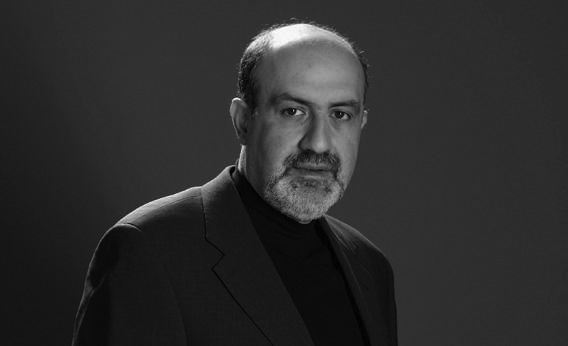
If I can be able to choose any of my favorite authors to sit beside me during the long hour’s flight. I think my least favorite choice would definitely be Nassim Nicholas Taleb. Most people complain about Nassim Taleb’s arrogant attitude and how he despite journalist and economist or he coined it “suckers” in his book. This guy is never going to win an award for modesty and he probably thinks we are too stupid to have the conversation and perhaps wasted his time.
If you ask me whether I hate him or not. I rather say I find him amusing. We can’t blame Nassim Taleb behave the way he is. I think I probably understand why he acts the way he is, and the reason behind it’s because we people are constantly trying to prove how smart we are or we will never learn to be humble and admit that we are faulty and we can never understand the chaotic world.
I constantly thought of Heraclitus, Pre-Socratic Natural Philosopher while reading his book. (Incerto: Fooled by Randomness, The Bed of Procrustes, Antifragile, The Black Swan – I will read real soon) Heraclitus was famous for his insistence on ever-present change as being the fundamental essence of the universe, as stated in the famous saying, “No man ever steps in the same river twice”. Heraclitus’s vision of the world was that what is important is change, everything else is transitory and impermanent. Nassim was also from a well-off family that lost everything in the Lebanese War. This also made him focus on uncertainty and the nature of unpredictable events.
Before we go into the topic, let me dissect the central idea of Nassim Nicholas’s teaching in his Incerto series. In the book, The Bed of Procrustes, he warns us human facing limits of knowledge, and things we do not observe, the unseen and the unknown, resolve the tension by squeezing life and the world into commoditized ideas, reductive categories and prepackaged narratives which has explosive consequences. Much like tailors who take great pride in delivering the perfectly fitting suit, but do so by surgically altering the limbs of their customers. The Incerto series book is revolving around his main idea of how we deal and should deal, with what we don’t know.
In the book, Antifragile. He wrote; “The antifragile loves randomness and uncertainty, which also means-crucially-a love of errors, a certain class of errors. Antifragility has a singular property of allowing us to deal with the unknown, to do things without understanding them-and do them well. Let me be more aggressive: we are largely better at doing than we are thinking, thanks to antifragility. I’d rather be dumb and antifragile than extremely smart and fragile, anytime.”
The other book, Fooled by Randomness. He wrote; “Needles to say that this book falls squarely into the Tragic category: We are faulty and there is no need to bother to correct our flaws. We are so defective and so mismatched to our environment that we can just work around these flaws.”
Nassim’s idea and writing are always revolving around the world of Mythology, Epistemology, Methodology or Philosophy of Mind. Indeed, Nassim devoted his life and study in uncertainty and probability. And the probability is an introspective field of inquiry, as it affects more than one science, particularly the mother of all sciences: that of knowledge. No doubt, he must be reading a lot of Philosopher’s writing since the Ancient’s philosophy until the 19th-century philosophy.
I will talk about who influenced Nassim thinking and why he wrote about those thinkers that influenced his thoughts and work. Nassim’s often written about David Hume, John Locke, Karl Popper and other eminent thinkers. But these thinkers are notable for their contribution to the work of Empiricism and extreme Skepticism. Thales, Plato, Aristotle, and Socrates also appearing in Nassim’s latest best-selling book, Antifragile. For these eminent and influential thinkers in the ancient world contribute to the work of Rationalism, which we call “Reasons”. Other than that, we can see that Nassim often also wrote about Seneca, The Stoic Philosopher, Friedrich Nietzsche, The German Philosopher in Existentialism that influenced Nassim’s latest writing about Theory of Antifragility.
Recall that “No man ever steps in the same river twice” by Heraclitus view about the flux and chaotic universe it’s the central idea of his philosophy. Nassim trying to teach people how to deal with uncertainty and how we should deal with unpredictable events by becoming Antifragile. In the book, Antifragile, he describes that Seneca it’s the Stoic philosopher that solved the problem of antifragility. Because Seneca was into practical decision-making, he has been described by academics as not theoretical or philosophical enough. Other philosophers, when they did things, came to practice from theory. Another example, he describes Thales was a philosopher, and like some philosophers, he enjoyed what he was doing. But he got tired of his buddies with more transactional lives hinting at him that “those who can, do, and others philosophize.” What he trying to interpret here is, some philosophers like to “Reasons” with theory and logic. And others more practical philosopher are more into practical knowledge and action to prove and to prove the theory with experiment.
What we got here is actually the two method of philosophy proving the discovery of theory. One is “Rationalism”, and the other is “Empiricism”. There is a puzzle here, Let’s assume that philosophy can be divided into two broad camps: the rationalists (Plato, Aristotle, Socrates) and the empiricists (David Hume, Sextus Empiricus, John Locke). As I mentioned previously, “Reasons” its the center of the philosophy of rationalists, they think it is possible to find out certain metaphysical truths simply by means of rational reflection without the reference of sense experience. The empiricists think that knowledge is ultimately dependent on sense experience. But this led to assume a self and others to deny, some to stand by the notion of material substance and others reject it. So reason leads rationalists and empiricists into metaphysical contradictions. And in the case of empiricism, it points uncomfortably in the direction of Skepticism.
Recall that human facing limits of knowledge, and things we do not observe, the unseen and the unknown, resolve the tension by squeezing life and the world into commoditized ideas, reductive categories and prepackaged narratives which has explosive consequences from the book of The Bed of Procrustes. Nassim is trying to warn us human that no matter how much reason we have, we are always facing the limitation of knowledge about how we perceive the world (Daniel Kahneman – Cognitive Biases) But what can we know is only by experience and the loves of error to discovery about the world and by proving our theory wrong with extreme skepticism (Karl Popper – Falsification).
I will further describe more about why Nassim do not like about “Reasons” and prefer by being extremely skeptical and dumb from the writing of “Fat Tony debates Socrates” (Fat Tony is a fictitious character imagine by Nassim in the book of Antifragile):
Fat Tony: “Tell me, old man. Does a child need to define mother’s milk to understand the need of milk to understand the need to drink it?”
Socrates: “No, he does not need to.”
Fat Tony: “And my dear Socrates, does a dog need to define what an owner is to be loyal to him?”
Socrates: “A dog has….instinct. It does not reflect on its life. He doesn’t examine his life. We are not dogs.”
Fat Tony: “I agree, my dear Socrates, that a dog has instinct and that we are not dogs. But are we humans so fundamentally different as to be completely stripped of instinct leading us to do things we have no clue about? Do we have to limit life to what we can answer in proto-Brooklyn English?”
Without waiting for Socrates’s answer.
Fat Tony: “Then, my good Socrates, why do you think that we need to fix the meaning of things?
Socrates: ” My dear Mega-Tony, we need to know what we are talking about when we talk about things. The entire idea of philosophy is to be able to reflect and understand what we are doing, examine our lives. An unexamined life is not worth living.”
Fat Tony: “The problem, my dear Socrates, is that you’re killing the things we can know but not express. And if I asked someone riding a bicycle just fine to give me the theory behind his bicycle riding, he would fall from it. By bullying and questioning people you confuse them and hurt them.”
Fat Tony: “My dear Socrates…you know why they are putting you to death? It is because you make people feel stupid for blindly following habits, instincts, and traditions. You may be occasionally right. But you may confuse them about things they’ve been doing just fine without getting in trouble. You are destroying people’s illusions about themselves. You are taking the joy of ignorance out of the things we don’t understand. And you have no answer; you have no answer to offer them.”
Since we humans are faulty and defect, what we can do is only by minding our own business, curtailing all the unnecessary stuff and meaningless tasks, and try to avoid debt as much as possible to live with content life (Stoic Philosophy). By this he means that we are not going to be a monk only to prove others, we always can leverage skewness and asymmetry of results to gains maximum returns with minimum downside. As he puts it this way; “You need to know whether you do not like the pursuit of money and wealth because we genuinely do not like it, or because you are rationalizing your inability to be successful at it with the argument that wealth is not a good thing because it is bad for one’s digestive system or disturbing for one’s sleep or other such arguments.” We called it sour grapes – as in Aesop’s fable – is when someone convinces himself that the grapes he cannot reach are sour (Friedrich Nietzsche – Slave Morality).
Other than that, we can find Nassim’s writings are full of ethical teaching that we shall not impose the disadvantage on other’s people life. He coined it ” Skin in the Game”. As he describes that the worst problem of modernity lies in the malignant transfer of fragility and antifragility from one party to the other, with one getting the benefits, the other one getting the harm, with such transfer facilitated by the growing wedge between the ethical and the legal.
Hence, this also encourages us should practice more about Stoicism. Logic, Reasons or “logos”, for the Stoics, encompassed not just the rules governing right inference but also what we would now call epistemology or theory of knowledge, as well as the philosophy of language. The Stoics claimed that their philosophical system was like an orchard – Logos (Logic) was the protective wall around it, Pathos (Physics) was the soil and the trees, and Ethos (Ethic) was the fruit. In a nod to Heraclitus, they held the world began in a great cosmic conflagration, and so it shall return in an endlessly repeating cycle of beginnings and endings. Every event is predetermined, governed by fate and entirely for the good. The Stoic argue that what matters most is the virtue, and virtue consists entirely in living accord with the whole and the divine universe. If things do not go accordingly, trust that the divine plan will work itself out no matter what, and there is nothing anyone can do about , but what one can do is react and embrace to the events in the right way, which is say harmoniously, virtuously, in tune with the flow of things. (This I personally think there is so much resemblance with the Eastern Philosophy of Taoism with the teaching of “Wu Wei”)
In the end, this is only the notion of my understanding and dissecting based on my months and hours of meditation and pondering about the subjects and teaching of Nassim after reading his published book. The general of this essay is the limitations based on my observation and experience of my own during my life and career. In a nod to Daniel Kahneman, we human can only judge and making decisions based on our availability-heuristic. (Simple method, If I say cat, in my mind, it only show Black Persian Cat, because I only observe the Persian cats in my entire life. But inside other people mind, there can be more than thousands of species of colors of cat) Therefore, if you think the teaching and philosophy of Nassim seem furiously inapplicable to you. I might suggest you move on and study your own philosophy by absorbing other thinkers. Since Theory are formed to be proven wrong by Science and tinkering. How many of us think the world is only aged 6000 years old based on the writing of the Bible and eventually proven wrong by Charles Darwin?
Further Study:
Stoicism: https://www.youtube.com/watch?v=R9OCA6UFE-0
Friedrich Nietzsche’s Slave Morality: https://www.youtube.com/watch?v=wHWbZmg2hzU
Karl Popper’s Falsification Theory: https://www.youtube.com/watch?v=wf-sGqBsWv4
Daniel Kahneman’s Cognitive Biases: Thinking Fast and Slow
Heraclitus’s Philosophy: https://en.wikipedia.org/wiki/Heraclitus

